Digital edition
$4.99
A PDF alone won’t make anyone a good investor - but it’s a good start.
PDF document

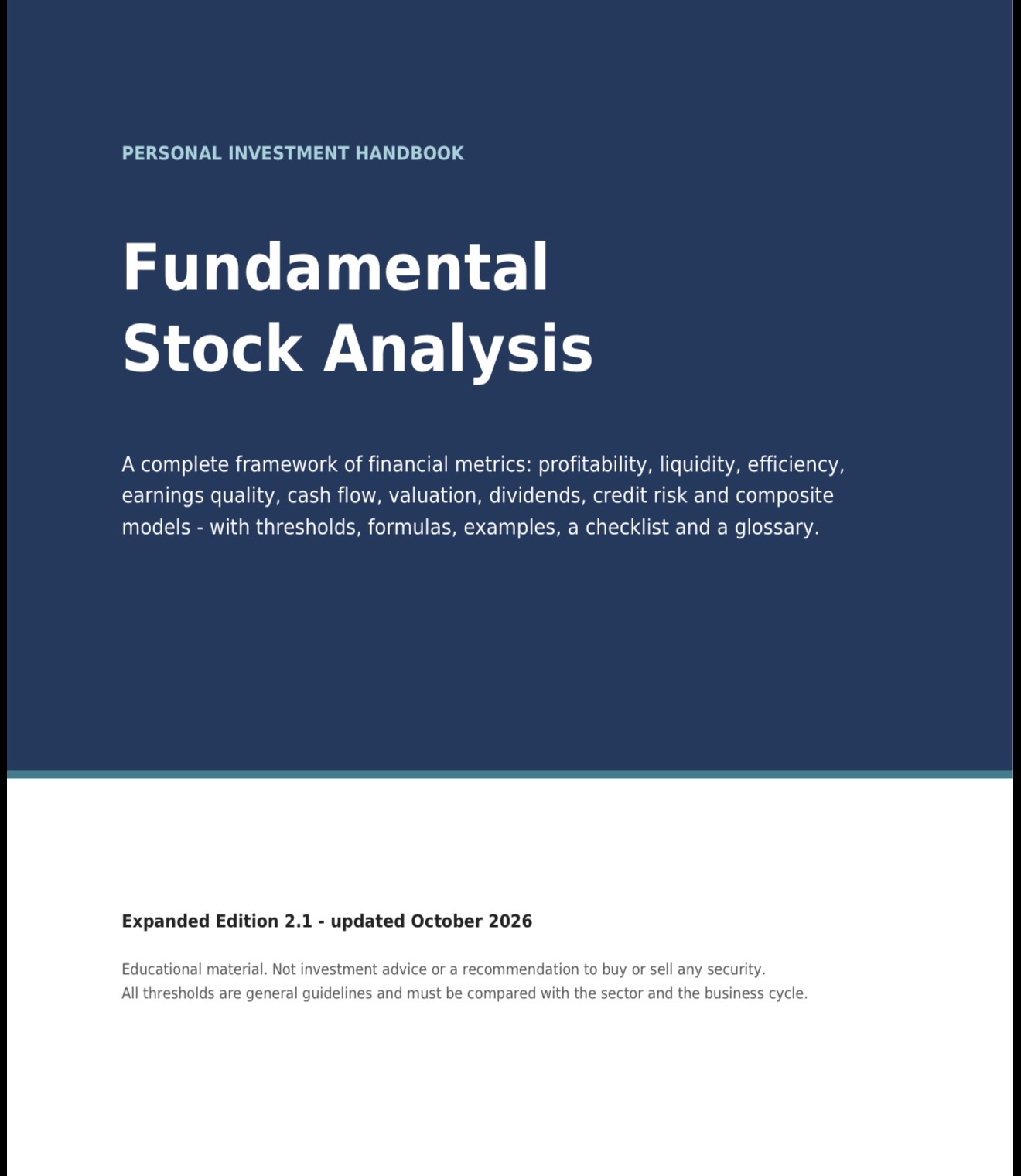
THE FINVARA HANDBOOK
A structured way to understand a business - beyond a single valuation multiple.
Look closer at profitability, cash flow, debt and valuation. Build a clearer picture of the company behind the stock.
Instant download · PDF
Is the business generating sustainable profits?
Do reported earnings translate into real cash?
Can the company meet its obligations?
What expectations are reflected in the price?
LOOK BEYOND THE HEADLINE NUMBER
A company can look inexpensive while carrying significant debt, producing weak cash flow or reporting earnings of questionable quality. Familiar metrics are useful - but they need context.
The handbook brings the pieces together into a practical analysis process. It does not predict future stock prices.
A PRACTICAL REFERENCE
From financial statements to a considered conclusion. Explore the topics covered, without losing sight of the business as a whole.
How much of each unit of revenue the business actually keeps, measured at gross, operating and net level. Margins are read in context - against the sector and the company’s own trend.
Whether the company can cover its short-term obligations. Why a very high value can be as telling as a very low one.
Return on equity, assets and invested capital - how effectively the business puts money to work. And why a high return borrowed through leverage deserves a second look.
Breaking return on equity into margin, turnover and leverage. Where the return actually comes from - and when it is fragile.
Reported profit versus the cash the business actually collects. Accruals, one-off items and the gap between earnings and operating cash flow.
Operating cash flow, capital expenditure and free cash flow. How much cash the company truly produces - and how that compares with its market price.
Earnings multiples, growth-adjusted ratios and enterprise value. Reading a price in the context of the sector and the company’s own history.
Price relative to book value and other asset-based measures. Conservative price ceilings for the defensive investor.
Yield and payout ratio, and what level is sustainable. Why a rising dividend on falling earnings deserves caution.
Debt relative to equity and assets, and the capacity to pay interest. The early warnings that appear before leverage becomes a problem.
The coverage ratios lenders themselves use. Whether the company’s obligations hold up when profits fall.
A composite score that estimates distance from financial distress. Reading both the value and the trend as an early signal.
Nine binary tests of financial strength, scored from 0 to 9. A quick first filter - not a final verdict.
Why the same ratio means different things in different industries. The adjustments that apply to banks, REITs and other special cases.
Profitability, growth, valuation and risk brought together in a single framework. What a green light looks like for each.
Two companies analysed side by side with the same data - including a stress test: what happens to each when earnings fall.
The most common mistakes and warning signs, from aggressive accounting to debt that needs refinancing soon.
A step-by-step checklist for analysing a stock - from the business model to the final decision.
All metrics and their reference values in one table. A summary to keep at hand during analysis.
An A–Z reference of terms, from accruals to enterprise value.
Where the data comes from - filings, regulators and benchmark datasets - and how to verify the numbers yourself.
WHO IT’S FOR
Follow a structured fundamental-analysis process
Understand financial statements better
Look beyond simple valuation multiples
Build your own company-analysis framework
Stock tips or buy/sell recommendations
Promises of investment returns
Short-term trading signals
Personalized investment advice
VALUATION UPDATES
Get an email when finvara publishes a new valuation of a company we have analysed ourselves.
Only valuation news - no other marketing emails.
THE EDITION
$4.99
A PDF alone won’t make anyone a good investor - but it’s a good start.
PDF document
Educational content, not investment advice.
The handbook is a digital PDF.
Yes. PDF readers are available for phones, tablets and computers.
The PDF is suitable for on-screen reading; printing depends on your PDF reader.
An update policy has not yet been announced.
No. The handbook is a digital PDF delivered immediately, so all sales are final - you explicitly agree to this at checkout. If the file is faulty, we will replace it.
The handbook costs $4.99. Any applicable tax is calculated at checkout based on your location.
No. This is educational material, not personalized investment advice or a recommendation to buy or sell securities.
FINVARA
A practical reference for a more considered analysis process.